

The Mythological Object
The Myths of the Moon / Part 2 of 3 / "Why the Moon?" Series

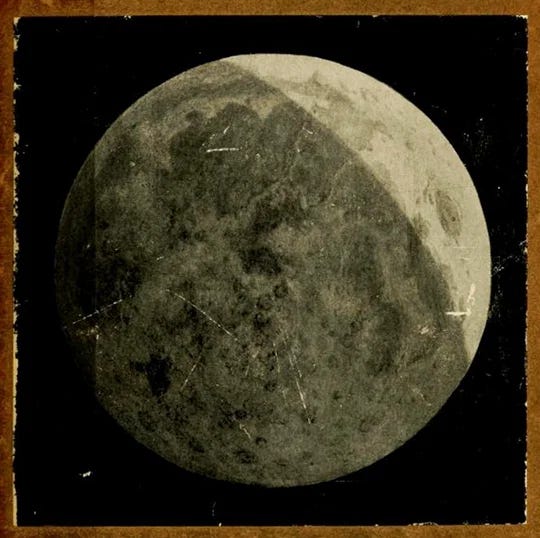
In May of 2019, NASA Administrator Jim Bridenstine announced that the agency’s program to return humans to the moon would be called Artemis. The naming had been suggested to him by NASA’s chief economist Alex MacDonald, whose father had read him the Iliad and Odyssey from memory as bedtime stories. Bridenstine introduced the name at a press conference. “It turns out that Apollo had a twin sister, Artemis,” he said. “She happens to be the goddess of the moon. I think it is very beautiful that fifty years after Apollo, the Artemis program will carry the next man and the first woman to the moon.” The choice was deliberate. Apollo, in Greek myth, was the god the original lunar program had been named for. Artemis was his twin sister, in later Greek and Roman tradition the goddess associated with the hunt. The mythological continuity was advertised. The program’s emblem features Artemis’s silhouette in profile, drawn against a stylized lunar disc, with the trajectory of an Orion capsule curving past her.
NASA has been naming its human spaceflight programs after gods and heroes for as long as it has had a human spaceflight program. Mercury, the messenger of the gods. Gemini, the twins of the zodiac. Apollo, the god of light and music. Artemis, the moon-associated goddess of the hunt. The pattern has held unbroken across more than sixty years. The technical achievements involved are unprecedented. The names borrow from antiquity. Ancient Greek and Roman pantheons preside over American rocketry.
We rarely ask why. The naming feels obvious. Of course we use mythological names for our most ambitious endeavors. Of course we reach for Apollo when we send humans to the moon. The obviousness, however, is itself revealing. It tells us something about how we already understand the moon. We name lunar missions after gods, not after physicists or engineers, even though physicists and engineers make the missions possible. The choice of gods over scientists, every time, every program, suggests that we know something about the moon that the technical language does not capture. What we know, without ever quite articulating it, is that the moon is a mythological object before it is anything else.
Mars Has a War God
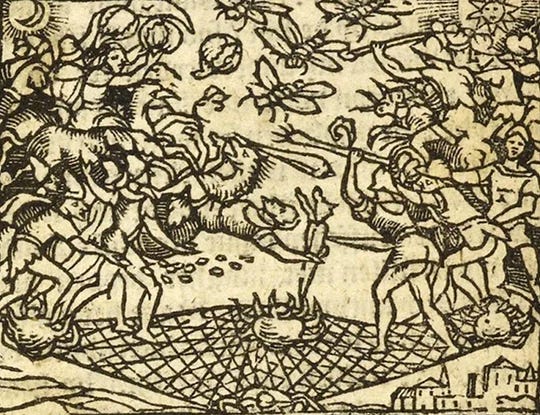
Compare the situation with Mars. If we were to begin naming Martian missions after gods, the pantheon offers us little. Mars in Greco-Roman mythology is Ares, the Roman Mars: a god of war, violence, and masculine aggression. Outside the Greco-Roman tradition, Mars carries little mythological weight. The planet is named for one god in one mythological tradition. Most cultures across human history have not assigned Mars a major role in their cosmologies. To them, Mars was simply a wandering star, sometimes red, sometimes notable for its retrograde motion, but not a body around which stories accreted. There are definitely myths about Mars, but not at the level nor permeation of the moon.
The contrast with the moon is severe. Virtually every culture that has had a culture has given the moon at least one god, and most have given it many. The moon is one of perhaps two or three universal mythological objects, the others being the sun and certain bright stars. No other body in the solar system that humans can plausibly visit comes close.
Mars has a war god. The moon has hundreds of gods, and many of them resemble us.
A Tour of Lunar Pantheons
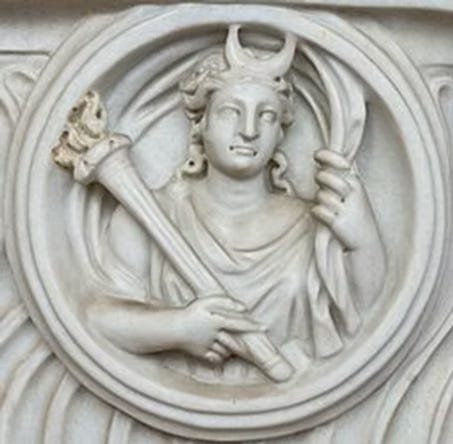
Greek tradition offered both Selene and Artemis. Selene is the moon itself, the titaness who drives a silver chariot across the night sky. Artemis became associated with the moon in the Hellenistic period, particularly through her syncretic identification with Selene. The Romans inherited both lines: Luna for the moon body, Diana as Artemis’s counterpart. By the late Roman period, the three were often interchangeable.
Chinese mythology gives us Chang’e, a goddess who drank a stolen elixir of immortality and ascended to live alone on the moon. She is accompanied by a jade rabbit, sometimes shown grinding herbs of immortality with a mortar and pestle. The rabbit is visible, in some Chinese traditional readings, in the lunar maria themselves. Chang’e is honored every year during the Mid-Autumn Festival, when families gather to eat mooncakes under her gaze.
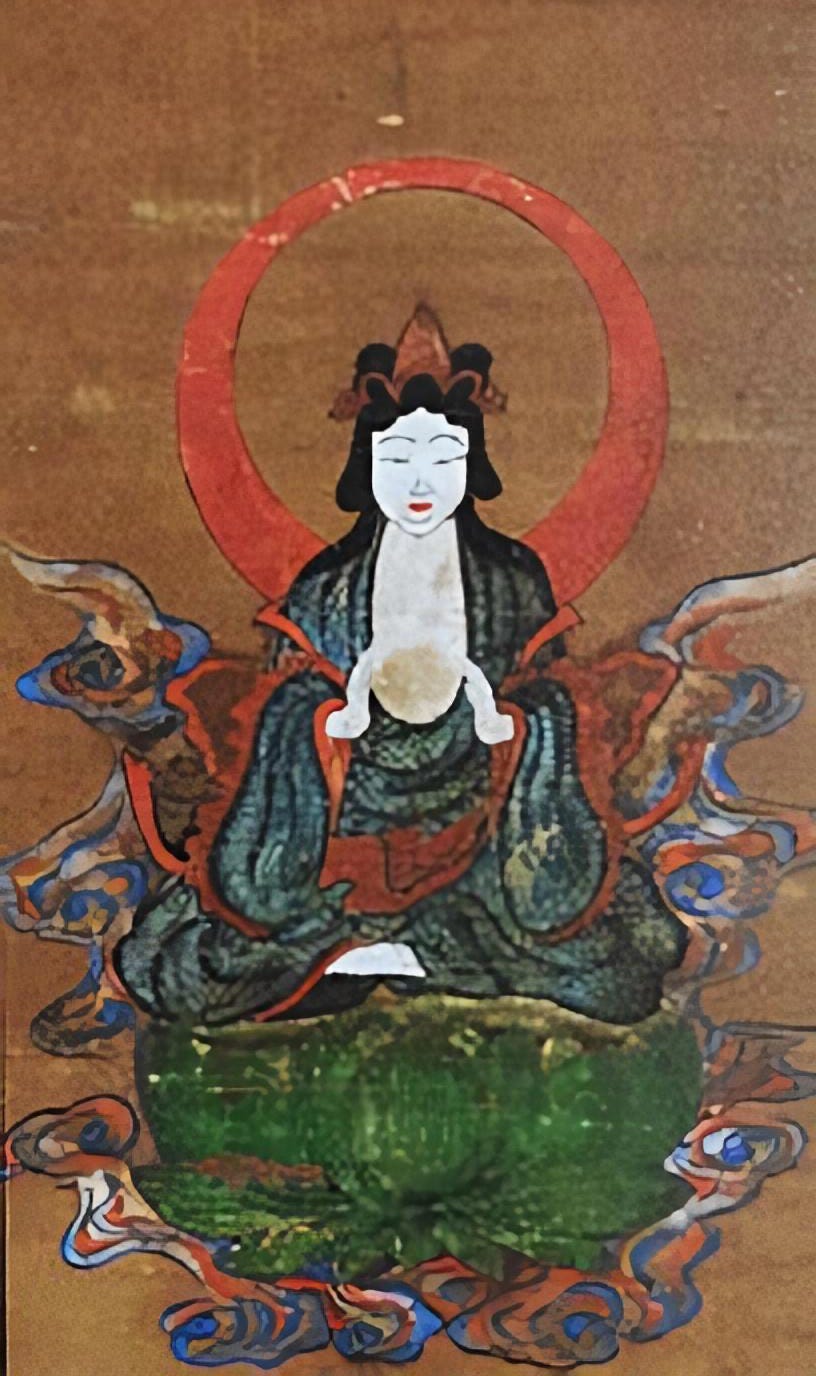
The Japanese moon god is Tsukuyomi-no-Mikoto, brother to Amaterasu the sun goddess and Susanoo the storm god. The Kojiki and Nihon Shoki record that Tsukuyomi was banished from his sister’s presence after killing the food goddess Uke Mochi, which is why the sun and the moon are forever apart, never seen in the same sky.
Mesopotamian tradition worshipped Sin, also called Nanna, as a major deity for thousands of years. He was the divine illuminator who watched over caravans crossing the desert at night, father to Shamash the sun god and Ishtar the goddess of love and war. The Sumerian city of Ur was sacred to him, and his Ziggurat of Ur still stands.
Khonsu was the Egyptian moon god, his name meaning “the wanderer” or “the traveler.” He was the protector of children at night and a god of time, his lunar phases marking the calendar. His temple at Karnak is one of the best-preserved in Egypt.
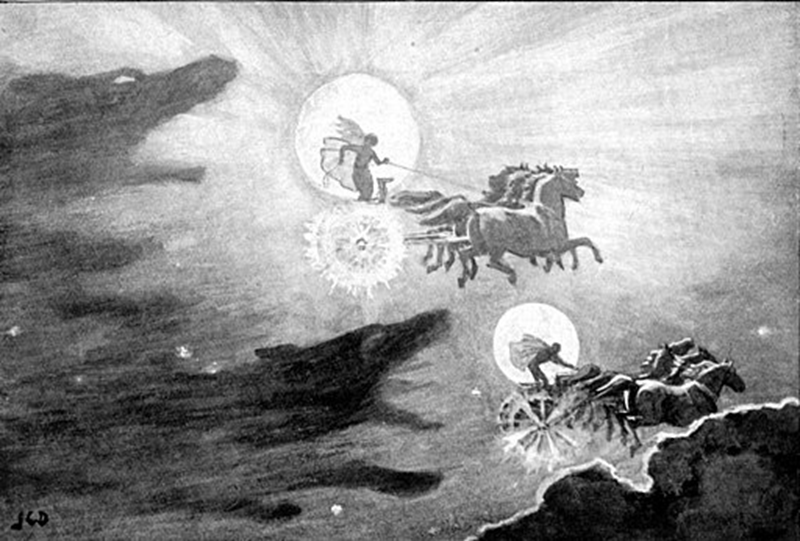
Norse cosmology personifies the moon as Máni, brother to Sól the sun. Both are pursued forever across the sky by wolves: Máni by Hati Hróðvitnisson, Sól by Sköll. At Ragnarök, the wolves catch them.
Mama Killa, the Inca moon goddess, was wife of Inti the sun god and mother of all those born on Earth. The Inca calendar was lunar. Lunar eclipses, in Inca cosmology, were caused by a celestial puma attacking Mama Killa, and the people would make noise to scare the puma away.
Coyolxauhqui, the Mexica moon goddess, was daughter of the earth goddess Coatlicue and sister to Huitzilopochtli the sun. She conspired against her mother and was killed and dismembered by her brother, her body cast into the sky, where it became the moon. The famous Coyolxauhqui Stone, discovered at the Templo Mayor in Mexico City in 1978, depicts her dismembered body in spectacular relief.
Polynesian Hina is a great mother goddess associated with the moon. In some Hawaiian traditions, Hina lives on the moon, having traveled there to escape the burdens of Earth. The dark patterns on the lunar surface, in these traditions, are sometimes Hina’s tools or her body itself.
The list could continue with the Yoruba, the San, the Maori, the Aboriginal Australians, the Hindu Chandra, the Slavic Khors, the Vedic Soma, and many others. The moon is feminine in some traditions, masculine in others, both in still others. The moon is mother, sister, lover, hunter, watcher, illusionist, wanderer, judge of the dead.
Time, Cycle, Madness, Tide
Beyond the personifications, the moon governs more aspects of human experience than any other celestial body. The English word “month” comes from the same root as “moon.” Old English mōnaþ derives from mōna, the moon itself. The same is true of German Monat, Latin mensis, Greek meis. The lunar month preceded the solar month in human reckoning. Lunar calendars are older than solar calendars. The Hebrew calendar remains lunar-solar. The Islamic calendar is purely lunar. In the literal etymological sense, our reckoning of time is lunar reckoning, even when we have layered solar correction over it.
The moon literally moves the oceans. Every coastline twice a day shows the lunar pull made visible. The Bay of Fundy in Canada has tides that rise more than fifty feet because of the moon. The fact that a celestial body can move the ocean from a quarter of a million miles away is the kind of evidence the human imagination has always needed for its mythologies.
And madness. The English word “lunacy” derives from Latin luna. The belief that the moon affects mental states is documented from Hippocrates onward. Modern psychiatric studies have largely failed to confirm a lunar-madness link, but emergency room nurses and police officers still report folk wisdom about the full moon. The word remains in our language, an etymological fossil of a mythology we have only partially abandoned.
What It Means to Walk on a Goddess
When Buzz Aldrin landed on the moon in July of 1969, he carried with him a small communion kit: bread, wine, a chalice. Before stepping onto the lunar surface, he took communion inside the lunar module. The sacrament was Christian. The body he was about to step onto was, in another religion’s reading, the goddess Selene. In another, Khonsu. In another, Hina. The mythological layering of that moment is intense. A Presbyterian elder consumed the body of one god while standing on the body of another.
This is what it means to walk on the moon. The moon is not unclaimed territory. It is mythologically populated, and every culture that has named it has populated it. The astronauts who walk on it walk on accumulated narrative.
When Wiseman, Glover, Koch, and Hansen passed within four thousand miles of the lunar surface in April of 2026, they were entering the same mythic space. They observed the surface. They named provisional craters. They watched Earthrise from lunar orbit. NASA’s social media coined the term “Moon joy” for the public response. The crew did not land. Artemis III, in 2027, intends to. When that happens, the astronauts who walk on the surface will walk on Selene’s body, on Khonsu’s domain, on Mama Killa’s face. They will walk on what every human culture has been imagining for as long as humans have imagined.
Mars cannot be entered this way. When humans walk on Mars, they will walk on rust-colored basalt and frozen water. This will be a profound achievement. It will not, however, be a mythological homecoming. The mythological density that surrounds the moon has no analog at the surface of the red planet. In this strict sense, Mars is a planet, and the moon is something more.
The Crew as Ambassadors
Here is what makes Artemis II and III mythologically distinctive. The moon was first walked by twelve American men, all of similar background, between 1969 and 1972. The mission was mythologically one-sided. The moon, in human imagination, is feminine in many traditions and shared across all peoples. The astronauts who first stepped onto its surface represented one nation, one sex, one ethnic background.
Artemis is changing this. Christina Koch became, in April of 2026, the first woman to travel beyond low Earth orbit and around the moon. Victor Glover became the first person of color. Jeremy Hansen became the first non-American. Reid Wiseman became, at fifty, the oldest. The next mission will land. The first woman to walk on the moon will likely be on that mission, fulfilling the program’s stated intent.
The mythological significance of this is not symbolic decoration. Joseph Campbell argued, in his late writings on space and the formation of new mythologies, that planetary myths require representative humanity engaging the new sphere. A planetary mythology cannot be founded on partial witness. The Apollo crews were not, by this standard, sufficient ambassadors to the lunar mythological space they entered. They were the first humans to walk on the goddess. They were also, mythologically speaking, only beginning the encounter.
The Artemis crews complete what Apollo started. They make the lunar encounter representative. They enter the mythic space as the diverse humanity that has been telling lunar stories for two hundred thousand years. This matters because mythology requires fidelity to who is telling it.
The Place Already Made
Mars, when we get there, will be a place we make mythic. We will tell stories about the first Martian footprint. We will name craters after explorers. We will, eventually, generate a Martian mythology of our own. The mythology will be ours and it will be new.
The moon is already the host to so many of our myths. We are returning to a place that has been waiting in the human imagination for as long as the human imagination has existed.
This is the deepest answer to the question of why we are going. The moon is the only body in the universe we can travel to that already lives inside us as a full mythological inheritance. To walk on it is to enter the place where every human culture has been telling stories. To return to it, after fifty-three years, is to resume a conversation we left mid-sentence.
Mars will be the place we eventually bring new myths to. The moon is the place that has already been mythologizing us.